For Veterinarians

Longevity, with the reasoning attached.

Plainvue Pet reads a full panel the way a clinician does: across systems, against breed and age, with a differential and the confirmatory test named. Every recommendation traces to a rule you can open and examine.

It reads the panel the way you would.

Most interpretation tools evaluate one analyte at a time against a single population range. Plainvue Pet evaluates the panel as a system. It connects findings that are unremarkable alone and meaningful together, weighs them against breed-specific reference intervals and the patient’s own history, and produces a short differential with the test that separates the possibilities.

Olive is the case that makes the point. Her owner mentioned she had stopped grooming and was drinking more. Neither observation is a lab finding on its own. Read alongside her panel, they pointed at kidney disease early enough to change what happened next.

A differential, and the test that resolves it.

For an abnormal or borderline result, the engine names the conditions worth considering for that breed, age and presentation, then names the specific follow-up test and the interval at which it matters. The output is a starting point for a workup, not a conclusion. The clinician decides what gets ordered.

  • Breed-specific reference intervals rather than one population range
  • Findings connected across ten body systems rather than flagged one at a time
  • A named confirmatory test, with the rationale, for every recommendation
  • Rules open to inspection, so the logic can be checked rather than trusted
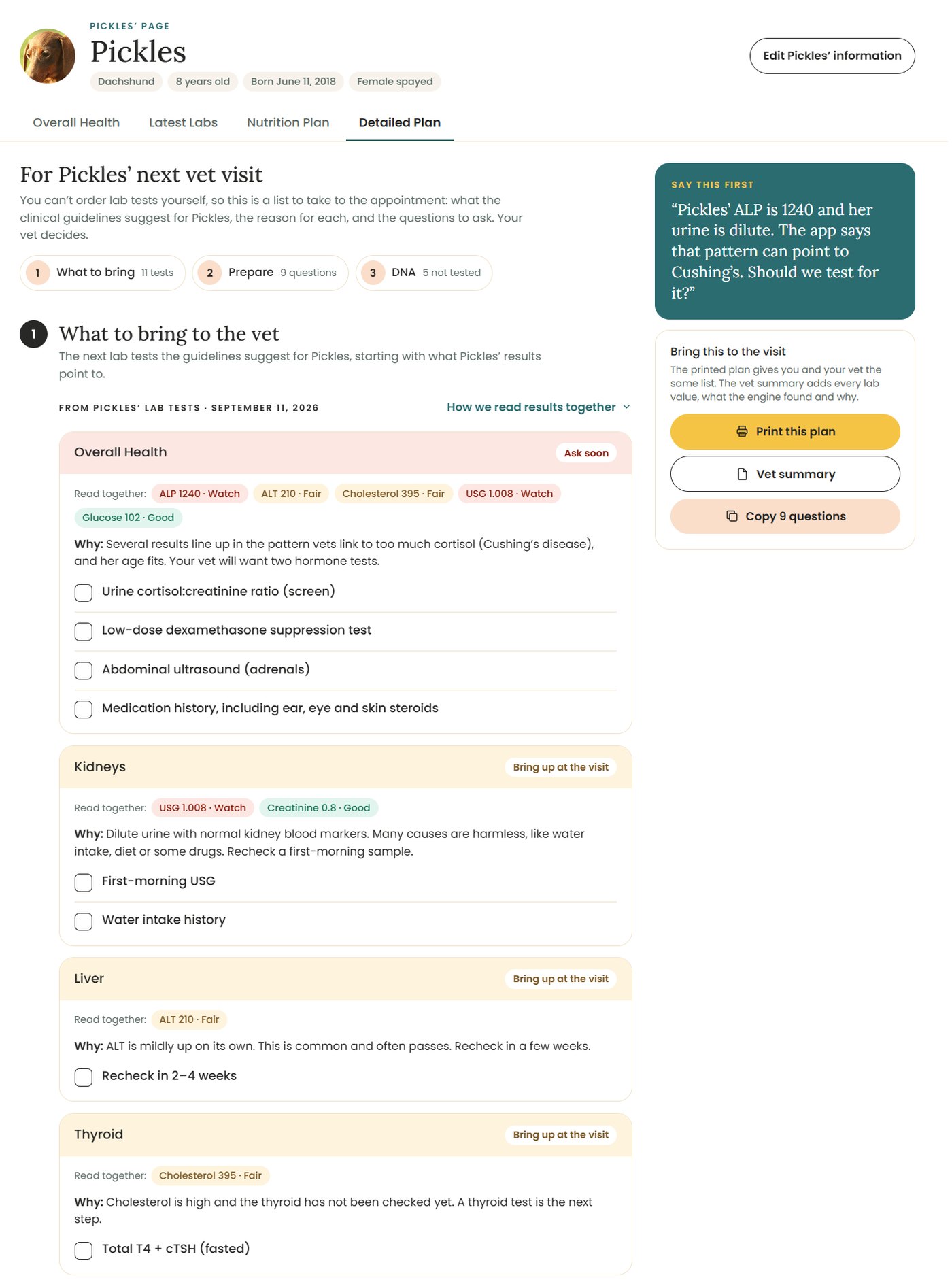
Plainvue Pet detailed plan showing four results read together and the follow-up tests to ask a veterinarian about

Early is the only lever that matters.

Nearly everything that shortens a dog’s or cat’s life is manageable at stage one and expensive at stage three. The gap is rarely knowledge. It is follow-through: a borderline value nobody revisits, a confirmatory test that never gets ordered, an owner who never understood why it mattered. Plainvue Pet exists to close that gap, which is another way of saying it exists to add years.

In practice that means the borderline ALT that gets rechecked in three weeks instead of next year, the dilute urine that prompts a first-morning sample, the thyroid panel added before cholesterol has been high for two years running. None of it is heroic medicine. It is ordinary medicine that actually happens.

Built on human medicine, adapted for yours.

Plainvue Pet is the veterinary arm of Plainvue, whose interpretation engine was built for human medicine by a team led by Dr. Jim Norman, one of the most experienced endocrine surgeons in the world. Endocrine disease is also the most common category of disease in dogs and cats, and the glands that fail first fail in much the same way in both species. Plainvue holds eight pending patents.

Dr. Jim Norman
Dr. Jim Norman
Founder and Chief Executive Officer, Plainvue

Clinical direction.

Dr. Eleanor M. Green, DVM, DACVIM, DABVP, is Chief Medical Officer of Plainvue Pet and is responsible for the veterinary soundness of every rule in the engine. She served more than a decade as the Carl B. King Dean of Veterinary Medicine at Texas A&M University, was Founding Dean of the Lyon College School of Veterinary Medicine, and has served as president of four national veterinary organizations.

Dr. Eleanor M. Green
Chief Medical Officer, Plainvue Pet

Talk to us before the January launch.

If you run a clinic, a laboratory or a referral practice, we will walk you through the engine, show the reasoning behind a real case, and answer the questions you should be asking. Say so on the contact form and we will set up a walkthrough rather than adding you to the consumer waitlist.

Request a walkthrough

Plainvue Pet supports veterinary care. It does not diagnose and does not replace clinical judgment.